|
|
 |
|
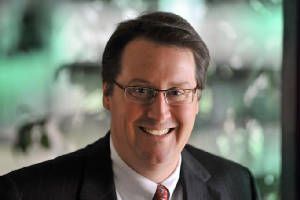
Jonathan Wilson is an
Atlanta attorney with more than 19 years of experience guiding growing private and public companies. He currently serves
as the outside general counsel of several companies and is the former general counsel of Web.com.com (NASDAQ: WWWW) and EasyLink
Services (NASDAQ: ESIC). He is also the founding chair of the Renewable Energy Committee of the American Bar Association's
Public Utility Section.
|
|
|
|
Friday, April 29, 2005
Enough is Enough: End the Filibuster Debate
Harry Reid, the Democratic Senate leader, calls Majority Leader Bill Frist's proposed compromise on judicial appointments
a "big wet kiss to the far right".
Certainly this is one of the more uncomfortable non-sequiturs uttered in public in a long time. Does it suggest
that that the Majority leader is "enamored" of the far right or that he is merely unhygienic. I can't tell.
In any event, is this any way for a Democratic Party leader to talk about the procedure of federal judicial appointments?
Has the world's greatest deliberative body sunk this low?
The Majority Leader's proffered compromise was both sincere and meaningful. In exchange for agreeing not to filibuster appointments to the Supreme Court
and the Courts of Appeals, the majority would agree to permit a full one hundred hours of debate on each nominee before a
full vote.
Before 2003, the Senate had never filibustered a nominee to the Court of Appeals and had only filibustered a Supreme
Court nominee once.
Frist's proposal would still permit the minority part to engage in precedent-breaking filibusters of district court nominees.
In response, Ralph Neas of People for the American Way proclaimed, "Sen. Frist is playing games with the Senate and the American people, and he should be ashamed of himself."
"Ashamed" of himself? For offering a compromise that would allow the minority 100 hours of debate time?
I don't recall the Democrats offering the Republicans this kind of a forum for their views when Bill Clinton was in the
White House and his party held a slim Senate majority.
The tone of these responses, as well as much of the analysis of the filibuster issue itself, bends language beyond the
breaking point.
If there has never been a partisan filibuster of a federal judicial nominee, how does it offend the Senate's tradition
to change the rules to prevent one?
As Sean Rushton points out, in 1995, leading Democrats Joe Lieberman and Tom Harkin proposed a change to Senate rules to eliminate all filibusters,
calling them "legislative piracy".
Nineteen Senators voted in favor of the rule change, including Ted Kennedy and John Kerry.
Senate Democrats seem to think that if they say it loud enough, often enough, and in the most colorful tones possible,
their backwards view of reality will come to pass. Uncritical repetition of these rants by a sympathetic mainstream
media gives them credence.
In fact, it is those opponents of the present nominees who have become unglued from reality.
The filibuster has traditionally been a tool of last resort, used rarely and sparingly and it has been used to filibuster
a judicial nominee only once. Senate Democrats are the ones who are violating Senate tradition with an unprecedented
use of the filibuster.
This debate has gone far enough. Senate Republicans should insist on an up/down vote on all judicial appointments,
through cloture when available or through a rules change if necessary.
Thursday, April 28, 2005
Filibuster Roundup - II
Hat tip to TraderRob at OpiniPundit for his citations to Senate Democrats who have switched their positions, including this zinger:
"I have stated over and over again on this floor that I would . . . object and fight against any filibuster on a judge,
whether it is somebody I opposed or supported . . ." -- Senator Leahy, Congressional Record, June 18, 1998
He also links to a backgrounder on the role of the filibuster in past judicial confirmation fights that is especially illuminating.
As this paper recalls, apart from the Abe Fortas filibuster, the Senate has never filibustered
a judicial appointment at the court of appeals or district court level.
Filibuster Roundup
Bob Dole says that amending the Senate's rules would be unnecessary if only Senate Democrats would forswear use of the filibuster.
Writing in the Wall Street Journal, Pete Du Pont recounts that many Democratic Senators have had a change of heart when it comes to the propriety of filibusters:
Other Democratic senators have had similar changes in belief: Joe Biden and Robert Byrd, Tom Harkin, Ted Kennedy, Joe
Lieberman, Pat Leahy, Chuck Schumer and their erstwhile colleagues Lloyd Bentsen, and Tom Daschle have all vigorously opposed
the use of the filibuster against judicial nominations. Mr. Schumer was for voting judicial nominations "up or down" without
delay.
Mr. Leahy flatly opposed a filibuster against Clarence Thomas's Supreme Court nomination: "The president and the nominee
and all Americans deserve an up-or-down vote." Mr. Harkin believed "the filibuster rules are unconstitutional," Mr. Daschle
declared that "democracy means majority rule, not minority gridlock," and Mr. Kennedy that "senators who believe in fairness
will not let the minority of the Senate deny [the nominee] his vote by the entire Senate."
But that was then, when Democrats controlled the Senate. Now, they are a frustrated minority and it is different. Mr.
Leahy has voted against cloture to end filibusters 21 out of 26 times; Mr. Kennedy, 18 out of 23. Now all these Senators practice
and defend the use of filibusters against judicial nominees.
Lost in much of the debate is a sense of what the Constitution actually requires and what is simply a matter
of Senate rules. Senate rules, after all, can be changed by a majority vote of the Senate.
As Du Pont notes, the Constitution requires that the Senate "advise and consent" on the appointment of judges
by majority vote:
The Constitution requires a two-thirds vote to override a presidential veto, pass a constitutional amendment, approve
treaties or expel a member of Congress. But all it says about judges is that they are appointed by the president with "the
Advice and Consent of the Senate." Absent a constitutional requirement for a supermajority, a majority vote is sufficient.
The U.S. Supreme Court affirmed that principle in 1892.
There is no mention of a Senate filibuster in the Constitution and, for much of its history, the Senate rules
did not even contemplate such a maneuver.
In 1806, for the first time, the Senate amended its rules so that a unanimous vote was required to end debate.
In essence, this allowed a single Senator to prevent the majority from voting on any matter.
This rule was amended in 1917, as Du Pont recounts, when "President Wilson, frustrated by a dozen Senators filibustering
a wartime defense bill, observed that "the Senate of the United States is the only legislative body in the world which cannot
act when its majority is ready for action."" The consequence was the Senate's adoption of Rule XXII, which replaced
the rule of unanimity with a two-thirds requirement. The rule was amended again in 1975 the number to three-fifths,
or 60 Senators.
Dick Morris says that the Republicans would do better to let the Democrats filibuster the appointments. Rather than the "virtual
filibuster" permitted by the current rules, he says, the Majority Leader should require filibustering Democrats to stay up
all night, enduring quorum calls around the clock -- for the enjoyment of C-Span and anyone else who cares to watch -- until
the public ridicule of the process shames them into allowing and up or down vote.
That would be a high-stakes gamble, however. Once the media become engaged in that kind of spectacle no
one can safely predict the outcome. It could result in "public ridicule" for the minority party that tries to block
majority action, but it could also backfire in ways impossible to predict.
There has been only one Senatorial filibuster of a Supreme Court nomination and, if the 1968 nomination of Abe
Fortas to Chief Justice is any guide, there is considerable risk for the majority.
As an excellent summary on the Senate's web site recounts, the Republican minority used a filibuster to oppose President Johnson's appointment. At hearings on the appointment
(which were the first in which as Associate Justice attended and testified) Justice Fortas was forced to admit that he briefed
the president on secret Court deliberations, had pressured senators who opposed the war in Vietnam and received a secret stipend
(equal to 40% of his Court salary) to teach an American University summer course.
These revelations eroded support for Fortas' nomination and President Johnson was ultimately forced to withdraw
the nomination.
Wednesday, April 27, 2005
Responding to Professor Bernstein
David Bernstein, writing in the Volokh Conspiracy, suggests that my analysis of Janice Rogers Brown's dissent in Aguilar v. Avis Rent A Car may have "concede[d] too
much to Brown's critics."
While I'm honored that the professor, who knows much more about the law of 'hostile work environment' claims than I do,
approved of my analysis, I'm not sure that I concede much to Brown's critics.
Bernstein writes:
"Wilson writes, "[n]o one wants to encourage or permit the use of racial epithets in the workplace." Well, I certainly
don't want to encourage it, and I wouldn't permit it in my workplace (if I owned or managed a workplace), but I don't agree
that it's wrong for the government to ever "permit" it. First, I can easily see circumstances where the use of racial epithets
in the workplace, not directed at a particular party, would be privileged by the First Amendment. Moreover, current federal
law requires a hostile environment claimant to prove a "severe and pervasive" climate of hostility. A singular use of a racial
epithet by a coworker is almost certainly not sufficient to satisfy that standard (though there is a New Jersey case, decided
under more expansive state law, that holds that a single use of racial epithet did create an actionable hostile enviroment.)"
Not to pick nits, but I never intended to suggest that the federal government should (as if it could) outlaw
all racial epithets or (from another point of view) never 'permit' them. Indeed, that was the point of Brown's dissent
of which Bernstein and I both approve.
Perhaps I would have been clearer if I had written in the first place that "No responsible individual
would encourage the use of racial epithets or permit their use by that individual's employees."
As Justice Brown wrote in her dissent in Aguilar (quoting a number of epithets uttered by others), "these
[racist and discriminatory] expressions are protected by the First Amendment to the federal Constitution and by our state
Constitution. We as a nation so value the free exchange of ideas that we are willing to tolerate even offensive ideas,
knowing that 'one man's vulgarity is another's lyric' and today's heretical idea may become tomorrow's gospel." (citations
omitted).
Judicial Activism and Constitutional Meaning
Thomas Sowell, writing on the pending Senate showdown over judicial confirmations, notes that:
A disinformation campaign has already been launched to depict judges who believe in following the written law as being
"activist" conservatives, just like liberal activists.
Those who play this game of verbal equivalence can seldom, if ever, come up with concrete examples where conservative
judges made rulings that went directly counter to what the written law says or who made rulings for which there is no written
law.
It is indeed remarkable that the opponents of many of the current nominees can go so far in their mis-use of the English
language.
The current nominees are, in varying degrees, conservative judges. They would make judicial decisions based on
the plain language of statutes and the Constitution. They would follow traditional rules of judicial decision-making
and avoid imposing their own choices and views on the law. This is the very meaning of conservativism.
And yet their opponents denounce them for being "activists", "extremists" and "outside the "mainstream." How can
words be stretched to these conclusions?
Sowell correctly identifies the damage done by liberal activist judges who use the judicial pulpit to pronounce new law
for society:
"The damage that is done by judicial activism extends beyond the particular policies that happen to catch the fancy of
judges. Judicial ad-libbing creates a large area of uncertainty, making the law a trap for honest people and a bonanza for
the unscrupulous."
As Philip K. Howard described so accurately in The Collapse of the Common Good, when any activity is at risk of being condemned--after the fact--then no activity is free from legal risk. Freedom
becomes impossible when any action carries with it the potential for censure.
One of the current nominees, California Associate Justice Janice Rogers Brown , described how years of social decline (and years of liberal judicial activism) have debased our language and our understanding
of right and wrong:
"[w]e are living in a world where words have lost their meaning. This is certainly not a new phenomenon. It seems to
be an inevitable artifact of cultural disintegration. Thucydides lamented the great changes in language and life that succeeded
the Pelopennesian War; Clarendon and Burke expressed similar concerns about the political transformations of their own time.
It is always a disorienting experience for a member of the old guard when the entire understanding of the old world is
uprooted. As James Boyd White expresses it: "[I]n this world no one would see what he sees, respond as he responds, speak
as he speaks,"1 and living in that world means surrender to the near certainty of central and fundamental changes within the
self. "One cannot maintain forever one's language and judgment against the pressures of a world that works in different ways,"
for we are shaped by the world in which we live.
This is a fascinating subject which we do not have time to explore more thoroughly. Suffice it to say that this phenomenon
accounts for much of the near hysterical tone of current political discourse.
Our problems, however, seem to go even deeper. It is not simply that the same words don't have the same meanings; in
our lifetime, words are ceasing to have any meaning. The culture of the word is being extinguished by the culture of the camera.
Politicians no longer have positions they have photo-ops. To be or not to be is no longer the question. The question is: how
do you feel."
There is no easy solution for this phenomenon.
Congress can pass no law that will restore an historical sense of conservatism in the judiciary. Precedents established
decades ago by judicial activists, declaring law from the bench, cannot be expunged overnight. Balance can be restored
only over time and through years of more faithful Constitutional interpretation by subsequent generations of judges.
The fight over judicial confirmations is one that must be won by those who would restore this sense of balance.
It must be won not only in the Senate, but in the public square, through persuasion, debate and the emerging conservative
consensus.
Tuesday, April 26, 2005
Wendy's "Chili Finger" Hoax A Sign of Societal Decline
Just as suspected, the alleged "chili finger" at a San Jose Wendy's fast food restaurant was no more than a hoax. While
questions regarding the severed digit are still being investigated, there are some questions not being asked, or at least,
not in the open.
***
Tort reform will only get us so far. It is clear we've been in the midst of a societal decline that needs its own reform.
We need to get back to a society that values morality and respect.
True enough. Changing the laws to eliminate the economic incentives that drive frivolous litigation is
important, but nothing can replace the value of a healthy society.
9:09 am edt
Campaign Finance and the Opponents of Litigation Reform
ANYONE still clinging to the notion that cam paign-finance reformers are interested in "clean government" solely for
its own sake should take a look at Illinois — specifically a race for a state Supreme Court seat last year that turned into
the most expensive judicial contest in U.S. history.
The race was a money magnet — with more than $9 million spent by the time the dust cleared. Why? Because tort lawyers
from all over the country go to Illinois' Madison County to file lawsuits against deep-pocketed corporations. If Democrat
Gordon Maag won the Supreme Court race, the trial-lawyer gravy train would probably keep on rollin'. If Republican Lloyd Karmeier
won (he did), he was expected to start hitting the breaks (he has).
***
"I think they would like to cut anybody out of the debate who disagrees with their agenda," says Edward Murnane, the
president of the Illinois Civil Justice League.
To bolster his case, he points to the liberal foundation funding behind the Illinois Campaign Reform Coalition, an umbrella
group in the state lobbying for sweeping restrictions on political speech. That funding is detailed in another report just
released by his group.
It turns out that the eight groups under the umbrella (ICPR, the Sunshine Project, the Citizen Advocacy Center, Protestants
for the Common Good, the Better Government Association, Common Cause Illinois, Illinois Public Interest Research Group and
the League of Women Voters of Illinois) have received about $3 million in grants from George Soros' Open Society Institute
and the Joyce Foundation since 1997.
The opponents of reform are wealthy and particularly adept at using the law to achieve their ends.
Unfortunately, the debate over litigation reform is a complex one. It's difficult to explain to non-lawyers how
the procedural rules of litigation create incentives for weak cases and how the mere filing of a lawsuit imposes costs on
the defendants and on society.
Muddling the debate through barely-veiled advocacy groups only harms the discourse and makes it more difficult for the
voters to understand the issues.
7:47 am edt
Monday, April 25, 2005
Growing Democracy in the Middle East
Which comes first: free elections or economic development?
That is among the questions asked by Sebastian Mallaby in his piece in today's Washington Post:
It's easy to want democracy for the Middle East. But what sort of democracy? Should American foreign policy focus on
promoting elections, or on checks and balances? Is the crucial question how power is achieved? Or is it how power is exercised?
Cheney Will Vote to End Filibuster
Speaking in front of the Republic National Lawyers Association, Vice President Dick Cheney indicated he would vote, as President Pro
Tempore of the Senate, to end filibusters over judicial confirmation votes:
"I believe there is an important principle at stake," he said. "When senators filibuster a nominee who has a clear majority
support, they are in effect trying to establish a 60-vote requirement for confirmation.
Sunday, April 24, 2005
Criticizing the Judiciary
A prominent member of the Senate leadership recently described a Supreme Court justice as "a disgrace." An equally prominent
member of the leadership of the House of Representatives on the other side of the political aisle has characterized another
justice's approach to adjudication as "incredibly outrageous." These excoriations follow other examples of personalized attacks
on members of the judiciary by senior political figures. So it is time to take a deep breath, step back, and inject a little
perspective into the recent heated rhetoric about judges and the courts.
We might start by getting a firm grip on the reality that our independent judiciary is the most respected branch of our
government, and the envy of the world.
***
But, absent lawlessness or corruption in the judiciary, which is astonishingly rare in this country, impeaching judges
who render decisions we do not like is not the answer. Nor is the wholesale removal of jurisdiction from federal courts over
such matters as prayer, abortion, or flag-burning. While Congress certainly has the constitutional power, indeed responsibility,
to restrict the jurisdiction of the federal courts to ensure that judges decide only matters that are properly within their
constitutional role and expertise, restricting the jurisdiction of courts in response to unpopular decisions is an overreaction
that ill-serves the long-term interests of the nation. As much as we deplore incidents of bad judging, we are not necessarily
better off with--and may dislike even more--adjudications made by presidents or this year's majority in Congress.
Olson's condemnation of recent personal attacks on judges is entirely sensible. Harry Reid's several verbal
assaults on Clarence Thomas were well beyond the pale and some criticism of the judiciary in the Schiavo affair was also inappropriate.
Olson also properly criticizes the confirmation process as part of the problem. If the legislature and
participating interest groups view judicial confirmation as an opportunity to take scorched earth stands on the political
implications of judicial rulings, why shouldn't judges think and act politically.
But Olson doesn't offer much of a solution either. Telling politicians to get a "grip" on reality is a nice
start, but it won't take us very far.
We need a more fundamental change in our understanding of the judiciary and the way in which judges should work.
That new understanding should not only inform Congress in its judicial confirmations, but should also inform judges in their
decisions and deportment.
Judges who view their role as policymakers open the door to the politicization of the judiciary. Judges who
view their role as neutral arbitrators of Constitutional principles have a greater claim to independence.
6:56 am edt
Saturday, April 23, 2005
Sandra Day O'Connor and International Law
Sandra Day O'Connor speaks out on the use of international law in Supreme Court decisions.
Finders Keepers and Jackpot Justice
Although Qui Tam litigation is only a small part of the larger problem of excessive litigation, this piece from TechCentralStation does a great job of identifying the perverse incentives created by the current law:
Fighting financial mismanagement and fraud throughout the agencies of the federal government is an urgent mission if
we ever hope to rebalance the budget. The Office of Management and Budget recently found that the Medicare program made $21.7
billion in improper payments to doctors, hospitals and insurers in 2004. Medicaid, with its overlapping state and federal
roles, also has rampant fraudulent claims. Unfortunately, the government's efforts at combating erroneous payments are pitifully
ineffective, thus encouraging more fraud, fueling medical inflation, and ripping off tens of billions of dollars from taxpayers.
Friday, April 22, 2005
Janice Rogers Brown and Her Critics
Many of the critics of Justice Brown have taken aim at quotation from a speech she made to the Federalist Society in
Chicago in April 2000.
The oft-criticized quote is "Where government moves in, community retreats, civil society disintegrates, and our ability
to control our own destiny atrophies." Critics charge that this suggests that Justice Brown dislikes government or somehow
believes that government is bad.
A full copy of the speech is available here, but even a more complete copy of the quotation brings it into better view:
At this moment, it seems likely leviathan will continue to lumber along, picking up ballast and momentum, crushing everything
in its path. Some things are apparent. Where government moves in, community retreats, civil society disintegrates, and our
ability to control our own destiny atrophies. The result is: families under siege; war in the streets; unapologetic expropriation
of property; the precipitous decline of the rule of law; the rapid rise of corruption; the loss of civility and the triumph
of deceit. The result is a debased, debauched culture which finds moral depravity entertaining and virtue contemptible.
But what if anything does this have to do with law? Quite a lot, I think. In America, the national conversation will
probably always include rhetoric about the rule of law. I have argued that collectivism was (and is) fundamentally incompatible
with the vision that undergirded this country's founding.
The New Deal, however, inoculated the federal Constitution with a kind of underground collectivist mentality. The Constitution
itself was transmuted into a significantly different document.
In his famous, all too famous, dissent in Lochner, Justice Holmes wrote that the "constitution is not intended to embody
a particular economic theory, whether of paternalism and the organic relation of the citizen to the State or of laissez faire."
Yes, one of the greatest (certainly one of the most quotable) jurists this nation has ever produced; but in this case,
he was simply wrong. That Lochner dissent has troubled me — has annoyed me — for a long time and finally I understand why.
It's because the framers did draft the Constitution with a surrounding sense of a particular polity in mind, one based on
a definite conception of humanity.
In fact as Professor Richard Epstein has said, Holmes's contention is "not true of our [ ] [Constitution], which was
organized upon very explicit principles of political theory." It could be characterized as a plan for humanity "after the
fall."
Newt Gingrich and the Crossroads of Conservatism - Part I
In Part I of this series I'll examine the premise behind Crossroads and the origins of the Speaker's thinking.
The Speaker begins by claiming that the conservative movement is at a crossroads in its development. He writes,
"Now at the very moment that members of the movement are in control of the White House, the House and the Senate, and many
governorships and state legislatures, conservatives find themselves at a crossroads."
He asks whether, as conservatives, "should we be comfortable with presiding over the bureaucracies, special interests,
and spending of the liberal government we have inherited or must we insist on transforming that obsolete system into a new,
more dynamic, and significantly different system of governing."
His arguments capture a sense that other conservative thinkers have voiced less pointedly: why is it that conservatives
in office behave differently than conservatives campaigning?
One answer is that there is an inherent difference in perspective that comes from "taking office". Speaker Gingrich
writes that "there is a difference between taking office and taking power." It is one thing for a conservative politician
to "throw grenades" on the campaign trail, but quite another to try to manage the institutions of power after you've won the
election.
In his introduction to Crossroads, Gingrich is suggesting that conservatives who take office should not only
espouse conservative principles but they should also govern differently than their liberal predecessors. He
calls this different method of governance "entrepreneurial public management" and describes it as using "the advances of science
and technology combined with the creativity of entrepreneurs and the power of the market to give people a broader range of
options . . . to offer more choices of higher quality at lower cost."
If he can truly develop a system of entrepreneurial public management that meets the high requirements of this definition,
Speaker Gingrich will accomplish something truly new.
For all of the victories conservatives have seen at the polls, and even in the legislative arena, conservatives have
not yet dismantled or truly re-invented any major area of government. Reform, to date, has been hesitant, piecemeal
and incremental.
Whether Gingrich can deliver on the promise of a new method of governing remains to be seen.
6:13 am edt
Thursday, April 21, 2005
Project 21 Demands a Fair Hearing for Brown
"The overriding concern liberals say they have about Janice Rogers Brown is the unsubstantiated claim that she is out
of the mainstream," notes Project 21 member Donald Scoggins. "If you look at her life and her achievements, she is well within
what anyone could rationally consider mainstream. In fact, she stands out as someone who embodies American ideals."
Associate Justice Brown is the daughter of an Alabama sharecropper who began her education in a segregated school. Her
family later moved to California where she earned a law degree and spent the last 25 years in public service. After serving
in lower state courts, she was appointed to the California Supreme Court in 1996. She was nominated to the D.C. Circuit in
July of 2003.
On the California Supreme Court, Brown wrote more majority opinions than any of her colleagues in 2001 and 2002. She
was retained by California voters with 76 percent of the vote. In a letter signed by 18 of her judicial colleagues, she was
described as "a superb judge" who is "extremely intelligent, keenly analytical and very hard-working" and a judge "who applies
the law without favor, without bias and with an even hand."
9:54 am edt
Fair Hearing for Janice Rogers Brown
In some quarters, Janice Rogers Brown is getting a fair hearing.
Jonathan Turley, a law professor I remember well from my days at GWU, says that Democrats should drop their filibuster
over Brown and nine other nominees. He writes:
Janice Rogers Brown of the California Supreme Court is equally conservative — she once called the New Deal a "socialist
revolution." But however inflammatory her remarks outside the courtroom, Brown's legal opinions show a willingness to vote
against conservative views, particularly in criminal cases, when justice demands it.
Turley's view is telling. He calls himself a "pro choice social liberal" and he is.
At GWU in the early 1990s he organized used book drives for prison libraries and volunteer clinics for indigent
defense.
Since then he's been seen on the Discovery Channel, describing his victory in a pro bono case for government
employees who claimed to become sick while working at the infamous "Area 51" on projects involving various chemicals.
His liberal credentials are impeccable, but he speaks the truth when he sees it.
When President Clinton got stuck on his zipper in the Lewinsky scandal, Jonathan Turley was one of the few liberals
to support impeachment, correctly concluding that lying under oath was exactly the kind of "high crimes and misdemeanors"
that ought to merit removal from office.
Turley wouldn't support Janice Rogers Brown, but he concludes that filibustering her appointment (and the bulk
of President Bush's other appointments) is simply wrong.
Wednesday, April 20, 2005
Janice Rogers Brown and the Mainstream
Numerous left-of-center organizations have opposed the nomination of California Supreme Court Justice Janice Rogers Brown
to the D.C. Circuit Court of Appeals, claiming that her views are out of the mainstream.
When these groups stoop to mention specifics, one of the cases most frequently cited is that of Oscar Aguilar v.
Avis Rent A Car System, 21 Cal. 4th 121 (1999).
Mitchell Zimmerman, writing in CounterPunch.org recently ventured into the realm of legal analysis when he described Justice Brown's position in Aguilar by describing a
"hostile work environment" in which the reader was subjected to racial epithets and wished to sue for employment discrimination:
Will the First Amendment bar your lawsuit?
Definitely not. Virtually every court that has considered the matter has concluded that racist speech can create a hostile,
abusive and discriminatory work environment, and that when it does so, a court can stop it. No court in recent decades has
held that the First Amendment gives people the right to use speech to harass fellow workers on racial or religious grounds
at work.
Just as a court can order a company to take down a "Whites Only" sign outside its employment office, even though this
is "speech," so judges have consistently held that other words can constitute unlawful racial discrimination, and that when
they do, the courts must step in and call a halt to such discrimination.
That is the established view under American law, supported by years of precedent. But it is not the view of Janice Rogers
Brown, President Bush's nominee to the D.C. Circuit U.S. Court of Appeals.
This would be damning, if only it were true.
Of course the First Amendment does not "bar" discrimination lawsuits. They happen all the time and Aguilar
v. Avis Rent A Car is a good example of one.
In Aguilar the plaintiffs, a group of Hispanic employees, complained that Avis permitted a hostile work environment to
exist because of the racial epithets uttered by a certain Avis manager.
After a jury trial, the court awarded most of the individual plaintiffs money damages ranging from $15,000 to $25,000.
In addition, the court issued an injunction that prohibited the Avis manager for uttering racial epithets.
On appeal, the California Court of Appeals reviewed the enforceability of the injunction and agreed that it was impermissible
under the First Amendment as written. The Court of Appeals ordered the trial court to re-write the order so that it was more
specific as to which words
the manager would be prohibited from uttering at work.
The Defendants sought further review of the injunction and three of the seven Justices on the California Supreme Court
upheld the reasoning of the Court of Appeals. A fourth Justice
agreed with the outcome, but for a different reason, and those four Justices constituted a plurality. Three other
Justices, including Janice Rogers Brown, dissented.
Mitchell Zimmerman's analysis -- as well as that of most of the liberal groups opposing Justice Brown -- ignore the issues
in the Aguilar case and the rationale behind Justice Brown's dissent.
First, by dissenting, Justice Brown did not detract at all from the rights of individual employees to sue for discrimination
under the "hostile work environment" theory.
The question of money damages was not even at issue in the appeal in Aguilar. The only question was whether the
trial court could enjoin a company manager from saying certain words at work.
Second, Justice Brown was not alone. She was one of three Justices who dissented from the plurality opinion on
First Amendment grounds.
Third, the decision in Aguilar is only a plurality opinion (because less than a majority supported its reasoning) and,
as a consequence, it is not even binding precedent in California. See Varian Medical Systems, Inc. v. Delfino, 113 Cal.
App. 4th 273 (2003) at fn 11 (noting that Aguilar is only a plurality opinion and not binding precedent). If
Aguilar's analysis is not even binding in California, how can it represent the "mainstream"?
Finally, the thrust of Zimmerman's critique (and that of the Justice's other opponents) is that by dissenting in Aguilar,
Justice Brown somehow condones racist talk or even workplace discrimination.
Of course this is absurd. In fact, one of the reasons why she dissented from the plurality opinion was because
the plurality's approach was impossible to reconcile with other free speech decisions involving offensive conduct that
refused to censor the
offensive speech.
As she wrote, "when we are confronted with bigotry, our visceral reaction is to strike back hard, which in this case
took the form of the tough injunction the court upholds today. But hostility, hatred, jealousy, resentment, envy and
vengefulness are passions as old and humankind and, though the expression of such sentiments may cause much misery and mischief,
hateful thoughts cannot be quelled at too great a cost to freedom."
Are these the words of an extremist?
Justice Brown was not blind to the impact her position would have on the rights of employees. She expected, as
is the case today, that employers would find ways to quell inappropriate workplace conduct as a matter of business efficiency.
She wrote, "this case is not . . . an all-or-nothing choice between either upholding the injunction or subjecting employees
to a "constant stream of [denigrating] verbiage." There is a middle ground: employees can sue and recover damages.
It is hard to imagine any employer would continue to tolerate discriminatory speech in the workplace after shouldering the
cost of litigation and a damage award and, if it did, it would run the risk of paying a second award, including
hefty punitive damages and attorney fees. It hink that remedy is sufficient to deter any "unwanted racial discrimination.""
There is an interesting and important debate to be had in the area of employment discrimination and free speech.
No one wants to encourage or permit the use of racial epithets in the workplace. Responsible employers routinely
prohibit such speech (and even less obnoxios but still inappropriate speech and behavior) through codes of conduct and the
like.
When employers fail to manage their employees responsibly, and plaintiffs can make out the requisite elements of employment
discrimination, affected employees can sue for damages.
The question in Aguilar -- which remains significantly unresolved in most courts -- is whether courts may issue orders
prohibiting certain kinds of speech in the workplace.
In this debate, under the facts in Aguilar, Justice Brown and two other California Supreme Court Justices also said "no".
Four other Justices said "yes".
One might disagree with her conclusion and her rationale, but one cannot say that it is out of the mainstream.
The conflict between workplace norms and free speech is an unsettled frontier in this area of the law and there are competing
values on all sides of the
conflict.
To the extent that Mitchell Zimmerman tries to suggest that the plurality opinion in Aguilar is an "established
view . . . supported by years of precedent" he is simply wrong.
Those who would criticize Justice Brown on her dissent in Aguilar are deeply mistaken and do no justice to the nomination
process by distorting her opinion or the law.
Blockbuster Case Removed Under CAFA
In one of the first instances of this new law, a purported class action against video rental firm Blockbuster has been removed from Oregon state court to the federal district court for Oregon.
According to local media reports:
Beth Creighton, the lead plaintiff and a Portland civil rights attorney, said she was infuriated to find out she had
to pay $1.25 for returning a late movie after Blockbuster launched it's "No More Late Fees" campaign in January.
In a previous agreement with state regulators, Blockbuster agreed to use large print in advertising to make clear that
customers returning a rental a week or more past the due date would be charged the full retail price. Returns 30 or more days
late would also be charged a "re-stocking" fee of $1.25 to $1.75.
"There are people out there who are not savvy enough or strong enough -- or crazy enough, I guess -- to take on this
issue, and they're being injured by it," Creighton said. "My philosophy is to stand up for the little guy, be it in my professional
life or personal life, and that's what I'm going to do."
Regardless of the merits of her claims, Ms. Creighton's case will be heard in federal court, rather than state court,
because the Class Action Fairness Act moves to federal courts putative state court class ctions where the claims have the
potential to exceed $5 million and a significant part of the class is outside the state.
For past posts on the Class Action Fairness Act try here, here and here.
Tuesday, April 19, 2005
Survey of Judges on Frivolous Litigation
An article in Business Insurance on April 11th cited a recent survey to the effect that a majority of federal district court judges believed that frivolous
litigation was either a "small problem" or a "very small problem". Unfortunately, that survey has been used as cannon
fodder by those who resist reforming the U.S. litigation system when it does not, in fact, support such a conclusion.
The primary cause of frivolous litigation in this country is the American rule of attorneys' fees (applicable in
49 of the 50 states) in which each party to a lawsuit (win or lose) pays its own attorneys. As a result, every plaintiff
gets a "free shot" at his defendant of choice. Even of the defendant "wins" (with a finding of no liability) the defendant
will never recover his lost attorneys' fees, expenses and the opportunity cost of lost time.
The survey was conducted in connection with a pending bill, the Lawsuit Abuse Reduction Act, which seeks to restore the original 1983 version of Federal Rule 11. That version would require federal judges to
impose sanctions on attorneys in frivolous cases. The original version was modified by Congressional Democrats in the
early 1990s to make such sanctions optional.
As a rule, judges hate being told what to do. Consequently, it's not surprising they oppose mandatory Rule
11 sanctions and prefer keeping the discretion they have under the current rule. This preference, in large measure,
explains their reaction to a survey on frivolous litigation in the context of this pending bill.
Monday, April 18, 2005
Fixing Sarbanes-Oxley
In the summer of 2002, after months and months of reports of corporate malfeasance and facing a campaign season in which
politicians were being associated with Ken Lay, Bernie Ebbers and the like, Congress passed a sweeping reform bill intended
to improve corporate governance.
The political and corporate worlds, both eager to restore public confidence in their respective institutions, hailed
the Sarbanes-Oxley Act as a cure-all.
* * *
I've learned two important lessons since coming to Congress. First, Congress simply doesn't work well when driven by
crisis. Our hasty efforts to improve airport security after 9/11 gave us tens of thousands of new screeners who are now employees
of the federal government but has yielded little in terms of improved passenger and baggage screening. . . .
Second, when hastily prepared legislation passes by an overwhelming margin, it is often not because it has been thoroughly
vetted and has earned a consensus. I would argue that Sarbanes-Oxley, which passed the House of Representatives 423-3, was
as much an attempt to politically inoculate Congress as it was an honest effort to improve corporate governance.
When I voted against it, I stated that the bill was so hastily crafted and overreaching that it was sure to create unintended
consequences that could actually hamper economic growth. Tens of billions of dollars in compliance costs later, this has most
certainly been the case.
A long-overdue voice of sanity.
Unfortunately, even if Congress fixed Sarbox now it would be too late to avoid the brunt of the damage.
By this time, nearly every public company has already spent the millions required to get into (or at least near) compliance
with Section 404. Reforming Sarbox would only remove the incremental costs going forward and remove the impediments
that current exist to using American public equity markets.
7:19 am edt
Santorum Will Vote to End Filibusters
The time has come for the Senate to reestablish that tradition [of majority vote on judicial nominations], to end these
destructive judicial filibusters and to give all judicial nominees the up-or-down vote they deserve
7:01 am edt
Novak Says Frist Has the Votes
Conservative columnist Robert Novak reports that Senate Majority Leader Bill Frist has more than enough votes to win a vote on ending
judicial filibusters:
Republican leaders count only two or three GOP senators who will vote against the
efforts to end, by a straight majority vote, filibusters on confirmation of judicial nominations.
Sens. Olympia Snowe of Maine and Lincoln Chafee of Rhode Island will not
support this move, and they are likely to be joined by Sen. John McCain of Arizona. That would mean 52 senators would go along
with the parliamentary maneuver attempting to end filibusters on judges. Only 50 are needed.
Saturday, April 16, 2005
Frist Fights Back
"They're ahead of the power curve," Sen. John Thune, R-S.D., said of the orchestrated effort by Democrats and groups
such as MoveOn.org and People for the American Way. "I think you'll see a greater, stepped-up message on part of the Republicans,
to go on offense on this issues."
Senate Majority Leader Bill Frist, after vowing last fall to stop Democrats from blocking the most conservative of President
Bush's nominees, will appear in a telecast later this month with leaders of social conservative groups.
6:25 am edt
Friday, April 15, 2005
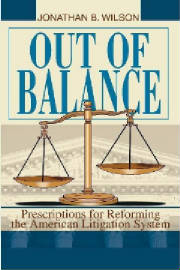
Leader of Mississippi Reform Effort Praises "Out of Balance"
“I have read the book, and I am impressed. Among other things, you address the transaction costs of litigation (attorney's
fees, expenses, etc.), which is the white elephant in the middle of the living room which few people want to discuss."
Senator Ross was especially interested in the model statute appended to the book that amends Fed. R. Civ. P.
68 to provide for the shifting of attorneys' fees in connection with an offer of judgment.
Your suggestion of a fee shifting procedure whereby the current offer of judgment rule
is modified to include attorney's fees, rather than just court costs, has a great deal of merit. I believe it is far superior
than some of the alternative ideas that have been tried . . . . Your proposal has the advantage of conforming judicial
procedure, rather than adding another extra-judicial system, and thus deserves serious consideration.”
Senator's Ross' kind words are very much appreciated. His description of the political
effort behind Mississippi's 2003 tort reform legislation is available here.
Comments from other early reviewers of Out of Balance should be forthcoming soon.
If you would like to review Out of Balance, please drop me a line at jbw@jonathanbwilson.com.
6:34 am edt
Thursday, April 14, 2005
Going Nuclear with Janice Rogers Brown
It is becoming increasingly likely that the Senate will have the opportunity to exercise the "nuclear option", forcing
an up or down majority vote on a judicial nominee, in the case of Janice Rogers Brown's nomination to the D.C. Circuit Court of Appeals.
Justice Brown currently sits on the California Supreme Court where she is one of its most conservative Justices.
She is noteworthy for a number of conservative opinions.
In Stop Youth Addiction, Inc. v. Lucky Stores, Inc., 17 Cal 4th 553 at 586 (1998) (Brown, J. dissenting) she
criticized the majority for permitting a frivolous lawsuit to go forward where the plaintiff (who was the plaintiff's attorney's
mother) had no real interest in the outcome other than to generate attorneys' fees. She wrote, "the majority chooses
to speed us along the path to perdition, genially opting for the worst of all possible legal worlds: abuse of process . .
. extortionate nuisance lawsuits, confusion and duplication of litigation resources and uncertain finality." She concluded
that the statute (which California voters modified by referendum in 2004) had become "a standardless, limitless, attorney
fees machine."
Wednesday, April 13, 2005
The 65 Percent Solution for Education
Patrick Byrne, the CEO of Overstock.com, has developed a proposal to re-vamp education spending that may get its first
tryout in Arizona.
According to the Tucson Citizen, Byrne's plan, which he calls the 65 Percent Solution, would require school districts throughout the state to spend at least
65% of their budgets on teacher pay and direct classroom costs.
"The state's 227 school districts had classroom instruction spending percentages ranging from 35 percent to 83 percent
in the 2003-04 school year, while the classroom spending ranged from 54 percent to 60.9 percent in the nine largest districts
in Pima County. The statewide spending average was 58.6 percent, according to the state Auditor General's Office. The national
average in the 2002 fiscal year was 61.5 percent.
Classroom dollars generally include teacher salaries and benefits, instructional supplies and aids, and activities such
as field trips. Costs for administration, food services, support services, transportation and building operations and maintenance
are excluded.
The Republicans said the mandate would make sure state education dollars are used to improve instruction without being
diverted for administrators' salaries and other non-classroom costs"
Byrne's organization, First Class Education, is working with teachers' groups to lobbying state legislatures to institute the reforms.
"School districts across the state have been robbing Peter to pay Paul out of necessity. Now they're going to be required
to do it by this ballot measure," said John Wright, president of the 30,000-teacher Arizona Education Association. "They're
not funding the system. Moving money around in an underfunded system doesn't improve the system."
Byrne's efforts have attracted the attention of some high-profile conservatives, including George Will who wrote that Byrne's plan:
"is politically delicious because it unites parents, taxpayers and teachers while, he hopes, sowing dissension in the
ranks of the teachers unions, which he considers the principal institutional impediment to improving primary and secondary
education. . . .
Nationally, 61.5 percent of education operational budgets reach the classrooms. Why make a fuss about 3.5 percent? Because
it amounts to $13 billion. Only four states (Utah, Tennessee, New York, Maine) spend at least 65 percent of their budgets
in classrooms. Fifteen states spend less than 60 percent. The worst jurisdiction -- Washington, D.C., of course -- spends
less than 50 percent."
Tuesday, April 12, 2005
Med-Mal Liability Reform
It's been a busy season already for tort reform, as physicians in four states saw their governors recently sign legislation
designed to help ease the burden of rising liability premiums.
12:55 pm edt
Monday, April 11, 2005
More on Faith and Politics
A U.S.C. history professor and a Democrat, Kevin Starr believes that his party has forsaken the Faithful ( Op-Ed in the LA Times).
Perhaps the outpouring of admiration for Pope John Paul II last week will at long last alert those at the helm of my
political party — the Democratic Party — to a truth that has yet to sink in despite the whack to the head administered by
last year's election: Cultural values count.
***
Government serves society, a much larger entity. And society, in turn, is structured and animated by a complex interaction
of beliefs, values, symbols and socio-economic forces which, taken cumulatively, we describe as culture.
***
Today's Democratic Party leaders have apparently forgotten, however, that the social programs that came of age during
the New Deal had their origins in Judeo-Christian tradition, even more than in secular humanism. Indeed, it might be argued
that popes were as influential as politicians in shaping policy.
In 1891, Pope Leo XIII (an Italian count, for goodness sake) helped usher in the modern era of social democratic thinking
with his encyclical Rerum Novarum, defending the rights of working people to organize themselves into unions and to achieve
a living wage.
In 1906, a Catholic priest, John Augustine Ryan, took on the modern American industrial system in his pioneering "A Living
Wage: Its Ethical and Economic Aspects," followed by "Distributive Justice: The Right and Wrong of Our Present Distribution
of Wealth" (1916).
In 1931, Pope Pius XI (a librarian, as well as a champion Alpine mountaineer, for goodness sake) extended Ryan's teachings
to the entire church in his encyclical Quadragesimo Anno.
In 1933, the pope named Ryan a monsignor, and a newly elected Franklin D. Roosevelt (a scion of the Anglo-Dutch Hudson
River aristocracy, for goodness sake) turned increasingly to the social philosophy Ryan represented as he fashioned the policies
and programs of the New Deal. Indeed, Ryan became popularly known as the Right Reverend New Dealer.
***
The Democratic Party, in short, made a powerful alliance with the culture of Ordinary America, including its religious
values. True, the party's links to segregationist Dixiecrats caused problems — big problems. But it was two Southerners —
Martin Luther King Jr. and Lyndon B. Johnson — who struck the most significant hammer blows against the injustice of that
dependency.
But now the Democratic Party elite — the activists, the pundits, the big-bucks donors — have succeeded in pitting social
democracy against the very values (one is tempted to say the very people) that gave rise to social democracy in the first
place.
Baffled by such rejection, an ostracized faith community shows every sign of realigning itself politically.
Perhaps that re-alignment has already occurred. In 2004, President Bush beat John Kerry by approximately 20% among
regular church-goers.
Saturday, April 9, 2005
Senate Judiciary Fun and Games
Failure of all eight Democrats on the Senate Judiciary Committee to show up for Thursday's session shut the panel down.
Now Bush's judicial picks can't get a hearing at all, much less a fair one.
Of the committee's 10 Republicans, eight were on hand to consider the appeals court nomination of Thomas Griffith. Not
one Democrat could be found. Four of them, including Patrick Leahy and Ted Kennedy, were in the congressional delegation attending
the funeral of Pope John Paul II.
The other four had no excuse, except the claim expressed through aides that they were unwilling to debate and vote on
the nomination with senior members in Rome. Committee rules require a quorum of 10 senators, so committee Chairman Arlen Specter
was forced to cancel the proceedings and reschedule.
IBD's conclusion:
Neanderthal? Does Kennedy consider Janice Rogers Brown, nominated to the D.C. Court of Appeals, the first black
woman to sit on the California Supreme Court, re-elected with 76% of the vote, the daughter of an Alabama sharecropper, a
Neanderthal?
Brown's crimes, apparently, include being (1) a staunch supporter of property rights, which she views as under
assault by eminent domain abuses, (2) an articulate voice for limited government and individual freedom and (3) a black conservative.
Liberals like Kennedy and Durbin tout "diversity" and "equality," but hypocritically oppose an Hispanic because
Estrada is a "dangerous Latino" and Brown because, as a Kennedy staff memo said, "We can't repeat the mistake we made with
Clarence Thomas."
It's time to exercise the "nuclear option" and restore majority rule to the U.S. Senate. If Democrats in league
with special interest groups want to shut that body down, voters can exercise the "Daschle" option in 2006.
1:44 pm edt
The Coming Nuclear Showdown in the Senate
There is a coming showdown in the Senate over minority Senators' ability to filibuster judicial nominees. Recently
some had thought that Majority Leader Frist might shy away from the confrontation, by The Hill reports that at least Senator Rick Santorum believes he is committed:
Sen. Rick Santorum (Pa.), the chairman of the Senate Republican Conference, has reassured conservative activist leaders
that Senate Majority Leader Bill Frist (R-Tenn.) is committed to triggering the “nuclear option,” stripping Democrats of the
power to filibuster judicial nominees.
Santorum met the leaders Tuesday to dispel growing anxiety among conservatives that Frist was wavering over what some
Republicans call the “constitutional” or “Byrd” option — a procedural tactic that would disallow judicial filibusters by a
ruling of the Senate chair and a ratifying majority vote.
Will this work or will it backfire? True believers like David Limbaugh are encouraging the Republican leadership to continue:
I think Republican Party honchos may be underestimating the grassroots passion over the judiciary. The outrage against
activist courts -- and by no means are all of them activist -- is real, growing and far from a fringe phenomenon.
We'll know soon enough. The Senate Judiciary Committee has scheduled Judge Priscilla Owen for consideration
next week and California Supreme Court Justice Janice Rogers Brown for the following week. As The Hill concludes,
this "means the soonest Republicans would trigger the tactic for Owen would be April 15 and the soonest for Brown would be
April 22, a GOP aide said."
Friday, April 8, 2005
Faith, Law and Politics
Howard Fineman writes, in Newsweek:
Looking back, it’s pretty clear what the 2004 election, at heart, was about: George Bush’s lock-and-load attitude towards
the use of military force against regimes allied with Islamist terrorists. Looking ahead, it’s pretty clear what the 2008
election, at heart, will be about: the role of religious belief in what theologians quaintly call “the public square” —especially
the federal courts and especially on “life issues” such as abortion, stem-cell research and the “right to die.”
Thursday, April 7, 2005
Judicial Independence
As if singing from the same hymnal, choruses of liberal activists have been decrying
threats to "judicial independence" in the past few days with startling coordination.
Much of the criticism seems to have been prompted by a letter from American Bar Association, Robert Grey. Grey's letter took a remarkable position,
seeming to equate recent acts of violence against judges (the shooting of Judge Rowland Barnes in Atlanta and the murder of Judge Lefkow's husband and child in Chicago) with criticism
of the judiciary and the judicial system:
As members of the legal
profession, I know you share my concern over the public's misunderstanding of the judiciary's role and the politically motivated
criticism of the judiciary stemming from the Terri Schiavo case, and are equally alarmed about the murders of Judge Lefkow's
family members in Chicago and the attacks at the Fulton County Courthouse in Georgia.
. . .
In the past several days,
I have issued public statements condemning the violence against our judiciary and the gratuitous and vicious public attacks
on the dedicated men and women who are our country's judges. During my speaking
engagements, I have taken the opportunity to call for a change in tenor when the national discussion turns to our justice
system.
Within a few days, Senator
John Cornyn made an ill-considered statement, wondering aloud whether recent attacks on judges were the product of pent-up
frustration over judicial over-reaching.
Senator Cornyn's comments
were quickly denounced (along with those of Congressman Tom DeLay, who had suggested impeachment as a possible options for
judges involved in the Schiavo case) by several columns, including the New York Times, which wrote:
The public's hope must
be that Senator Cornyn's shameful outburst gives further pause to Senate moderates about the threats of the majority leader,
Senator Bill Frist, to scrap the filibuster to ensure the confirmation of President Bush's most extremist judicial nominees.
Dr. Frist tried to distance himself yesterday from Mr. DeLay's attack on the judiciary. But Dr. Frist must carry the militants'
baggage if he is ever to run for president.
Senator Cornyn quickly
clarified his remarks, stating that he had no intent to encourage or condone violence, but rather that the
connection between violence and judicial over-reaching was worthy of note:
My point was, and is,
simply this: We should all be concerned that the judiciary is losing respect that it needs to serve the interests of the American
people well. We should all want judges who interpret the law fairly--not impose their own personal views on the Nation. We
should all want to fix our broken judicial confirmation process. And we should all be disturbed by overheated rhetoric about
the judiciary from both sides of the aisle. I regret that my remarks have been taken out of context to create a wrong impression
about my position, and possibly be construed to contribute to the problem rather than to a solution. Our judiciary must not
be politicized. Rhetoric about the judiciary and about judicial nominees must be toned down. Our broken judicial confirmation
process must be fixed once and for all.
What are Americans to
do if they are unhappy with the direction the courts have taken? They have elected and re-elected a president who promises
to appoint "conservative" judges, and they've elected a Senate the majority of whose members favor every judge the president
has nominated. Tough luck, says the Times, which approves of using the undemocratic filibuster to shield the courts from democratic
influence.
All Americans should stand
against political violence, which is a serious problem though mercifully also a rare one. Standing against democracy is something
else entirely.
More recently, the Democrats'
conflation of judicial criticism with judicial violence has spread to other outlets with the Columbia, South Carolina State linking judicial violence to tort reform:
There’s certainly nothing
wrong with monitoring the judiciary to make sure judges are fair and impartial; indeed, that’s healthy for the system. But
legislative leaders need to make it clear that they will not be party to any effort to unseat judges who make legally correct
rulings that displease powerful interests. If they don’t, our judges could feel intimidated into playing politics from the
bench, whether that was the goal or not.
Let's all take a deep
breath and start from the beginning.
Violence against judges
and the judicial system: wrong. Always. No exceptions.
Criticizing judges and
the judicial system: permitted. Appropriate. Healthy for our government and the rule of law.
What is especially mendacious
about this line of analysis, however, is the ease with which the left accuses anyone who criticizes the judiciary of having
improper motices or inadequate concern of judicial violence.
The ABA is as much to
blame as anyone. There was a time when the ABA was simply the national organization for lawyers. Joining the ABA
after graduating law school was as natural as your first pair of tasseled loafers.
Beginning in the late
1980s, however, the ABA turned left, picking up various left-wing causes, including abortion rights, tax policy, welfare
benefits and the like and trying to turn them into fights over "civil rights".
One of the turning points
came in the early 1990s when the ABA abandoned its traditional stance on abortion (which was that it was a political question
and not one on which lawyers could claim to have a special expertise) and instead took the position that the "right to an
abortion" was a "civil right".
The ABA suffered a loss
in membership but the remaining ABA members who chose to continue the group's leftward slant were emboldened.
As a consequence, more
than a decade later for the ABA President to suggest that the ABA "is committed to promoting the importance of judicial independence" is simply not credible. The political arm of the ABA, the House of Delegates,
has been on a crusade for nearly two decades to politicize the judiciary and has used its prerogative of reviewing judicial
qualifications as a tool for enforcing poltical correctness among judges.
If the ABA had kept itself
free of politics -- as many of us suggested it should in 1990 -- it could claim to speak purely about the value of judicial
independence. In light of its record, however, it cannot.
The
ABA's voice is only another one in the liberal choir.
Wednesday, April 6, 2005
Sandy Berger and the Prosecution That Never Was
I can only find one way to make the Sandy Berger story make sense.
As a handful of conservative commentators have noted recently, ( Rocky Mountain News and Dick Morris), former Clinton National Security Advisor Sandy Berger has cut a deal with prosecutors in connection with charges that he
illegally removed classified national security documents from U.S. government archives. He claims to have been reviewing
Richard Clarke's "after-action reports" of Clinton administration decisions not to strike at Al Quaeda while preparing
to testify before the 9/11 commission and then destroyed a number of those documents.
As part of his plea, he has agreed to pay a fine of $10,000 and lose his top secret security clearance for three years.
Dick Morris had one of the stronger reactions:
"Berger's "explanation" stinks: He claims he was too tired to review the documents in their secure venue, that eye fatigue
moved him to stash them in his pocket for later comparison in the leisure of his home and office.
That's nonsense. After all, he went back a week later and helped himself to more documents.
Berger would also have us believe he "inadvertently" cut up and "inadvertently" destroyed the documents — that he had
no intention of concealing anything from the commission. And then, I suppose, he inadvertently lied about what he'd done.
Come on. With a shabby explanation like that, Berger invites speculation that he is covering for himself or for the Clintons.
Back in the '90s, I found Berger consistently unwilling to act vigorously against terror-sponsoring nations. When Sen.
Al D'Amato proposed sanctions against Iran, Berger tried to get Clinton to veto the bill; it was only after much public pressure
that he signed it.
Berger was on a fast track to be the next Democratic Secretary of State. He risked that in stealing those documents.
Now he has destroyed his future career by pleading to a criminal misdemeanor — admitting what he did while still concealing
why he did it.
The Clintons' reaction when Berger was caught? The former president's comments sound just too scripted to believe: He
laughed and said that it was typical of Sandy to be disorganized and forget how he handled documents. Quite a comment about
the man he appointed to superintend the nation's secrets.
Then Hillary announced, without being asked, that Sandy had just helped brief her for a February speech at the annual
Munich Conference on Security Policy — sending the adviser a signal that he was still part of the family, even though the
grand jury was investigating him.
Picture the fevered atmosphere in the months after 9/11. Any indication by the commission investigating the attack that
the Clinton administration hadn't taken terrorism seriously would badly damage the former president's reputation and the former
first lady's chances. Any loyal adviser would have worked to mitigate the possible damage. The measure of how serious the
damage may have been is how far Berger risked falling to prevent it — and how far he did fall rather than reveal why."
It seems clear that Berger copped a plea in order to protect the Clintons. What's more troubling is why prosecutors
(who, after all, report to an Attorney General appointed by a Republic President) would let him get away with it.
The only explanation I can imagine (Full disclosure: This is rank speculation on my part) is that prosecutors feared
they couldn't put together a case or couldn't stomach the media reaction they feared would ensue.
Imagine the difficulty of preparing a case against Berger. You would want to interview those who might testify
to Berger's motives for taking the documents. Whom might that be? The Clintons.
Any prosecutor contemplating another case against a Clinton confidante would have to have nightmares with Ken Starr running
through his mind. Media outlets sympathetic to the defendant would call it Whitewater-II and urge everyone to just "move
on."
If you were the career DOJ attorney investigating Berger's case, would you want the media photographing you, travel mug
in hand, getting in your car every morning and peppering you with questions like those posed to Ken Starr?
I can't prove it, but I can't help thinking that the prosecution went soft on Sandy because they couldn't summon the
intestinal fortitude needed to delve again into the depths of the Clinton administration.
I don't know if I'm right, but that's about the only way I can understand this plea bargain.
Tuesday, April 5, 2005
California Supremes to Rule on Campbell Limits
Two cases are coming before the California Supreme Court for oral argument that will require the Court to consider how to apply the
U.S. Supreme Court's limitations on punitive damages in Campbell v. State Farm.
In Campbell, the U.S. Supreme Court held that an award of punitive damages must bear a reasonable relationship
to the plaintiff's actual damages and that in nearly all cases the numeric relationship between actual and punitive damages
should be a "single digit ratio".
In two cases, Simon v. San Paolo U.S. Holding, S121933, and Johnson v. Ford Motor, S121723, California
court have interpreted the "single digit ratio" requirement very differently and the California Supreme Court will have
to resolve these interpretations.
U.S. Chamber Discusses Litigation Reform in Illinois
The State of Illinois, notorious in litigation circles as the home of infamous "judicial hellholes" Madison and St. Clair
counties, has several pending bills pertaining to litigation reform.
The U.S. Chamber of Commerce Institute for Legal Reform will be addressing the prospects for reform in Illinois in a
conference call today.
Speakers include:
-- Doug Whitley, president, Illinois Chamber of Commerce
-- Lisa Rickard, president, U.S. Chamber Institute for Legal Reform
-- Ed Murnane, president, Illinois Civil Justice League
Illinois currently has bills pending that would divert the residue of class action settlement funds to non-profit organizations
(H.B. 2552), increase the evidentiary requirements in cases involving non-economic damages and require a bifurcated hearing on the elements
of non-economic damages (S.B. 1460) and change the venue provisions of the civil procedure code to limit the ability of plaintiffs' to shop for favorable fora
(S.B. 1724).
Monday, April 4, 2005
New Hampshire Med-Mal Reform
The New Hampshire House has passed a mel-mal reform bill that would require pre-screening by a trial judge before any
complaint could proceed.
The operative part of HB 702 describes how the trial judge should conduct a summary proceeding to determine if the case
can go forward:
Each such action for medical injury shall be heard by the screening judge within 45 days after the defendant’s answer
has been filed. At the screening hearing the burden of persuasion shall be on the plaintiff to produce such evidence as a
reasonable person might accept as adequate to support a conclusion. Admissible evidence shall include, but not be limited
to, hospital and medical records, nurses’ notes, x-rays, and other records kept in the usual course of the practice of the
health care provider without the necessity for other identification or authentication, statements of fact or opinion on a
subject contained in a published treatise, periodical, book, or pamphlet or statements by experts without the necessity of
such experts appearing at the hearing. The screening judge may, upon his or her own decision, summon or subpoena any such
records or individuals to substantiate or clarify any evidence which has been presented. The testimony of the witnesses and
the decision of the screening judge shall not be admissible as evidence at a trial.
As I describe in Out of Balance: Prescriptions for Reforming the American Litigation System, pre-screening systems like this often create more problems than they solve. HB 702 leaves too many questions
unanswered, raising the likelihood of further litigation and expense.
For example:
- Will the parties have discovery during this accelerated process? (If so, won't the parties still have substantial
attorneys' fees and costs? If not, how can the parties--or the court for that matter-- know what are the facts?)
- By what standard will the trial court determine if the case has enough merit "as a reasonable person might accept as adequate
to support a conclusion"? If this is a "simple preponderance" test, then isn't just like having a mini-trial, except
without any of the procedural rights a plaintiff would enjoy in an ordinary civil case?
- What evidentiary rules will the court follow, if any? The bill says that "admissible evidence may include, but not
be limited to" suggesting that there is other admissible evidence not listed. May the court consider hearsay?
What about other kinds of evidence that would be inadmissible at trial?
It's hard not to sympathize with the reformers, who seem to intend to reduce frivolous litigation and reduce healthcare
costs. I only wish I could share their optimism as to the efficacy of this kind of reform.
Saturday, April 2, 2005
Media Mis-Interpret Supreme Court's Age Discrimination Decision
The San Francisco Chronicle was probably the farthest from the mark when it reported, " The Supreme Court expanded job protections for roughly half
the nation's work force Wednesday, ruling that federal law allows people 40 and over to file age bias claims over salary and
hiring even if employers never intended any harm."
In reality, The 5-3 decision of the Court (Justice Rehnquist did not participate) was a measured analysis of the language
of the Age Discrimination in Employment Act and a reconciliation of the Court's past decision in Griggs v. Duke Power,
401 U.S. 424 (1971) with 1991 amendments to Title VII of the Civil Rights Act of 1964.
While it was a decision on which reasonable jurists could disagee, it should not be seen as a watershed event or the
making of significant new law. Justice Stevens wrote the opinion for a five justice majority that included Justices
Souter, Ginsberg, Breyer and Scalia (with respect to three of the opinion's four sections). Scalia differed with the
majority only on the rationale for the majority's conclusion. Justices O'Connor, Kennedy and Thomas agreed with the
majority's holding (affirming the Fifth Circuit) but disagreed with the majority's analysis.
The question was whether the 1967 ADEA admitted the possibility of a "disparate impact" discrimination suit. The
operative language of the ADEA is identical to the language used in Title VII of the Civil Rights Act of 1964 (Title VII being
the statute under which most employment discrimination cases involving race, religion and sex are litigated). The threshhold
question, therefore, was whether Congress intended the ADEA to be applied to age discrimination cases in the same way
that Title VII applies.
The facts of the case were fairly simple. The City of Jackson, Mississippi had developed an employee pay plan for
its police officers. The announced purpose of the plan was to increase the pay for junior officers because of a
perception that other jurisdictions paid more for junior officers. As a result, pay raises for more senior officers
(who tended to be older than the junior officers) were less generous than those for the younger officers. A group
of older officers sued, claiming discrimination based upon a disparate impact theory.
The Fifth Circuit held that the ADEA could never support a disparate impact claim and dismissed the officers' complaint.
The Supreme Court held that, while the ADEA could support a disparate impact claim, the types of disparate impact claims
permitted would be narrower than those permitted under Title VII. On the facts of this case, the Jackson officers did
not have sufficient evidence to support their claims. As a result, the Supreme Court affirmed the ruling of the Fifth
Circuit, although it provided a different rationale.
Attorneys specializing in discrimination cases will want to consider Justice Stevens' analysis of the ADEA and the two
ways in which the majority says the Court will restrict the scope of disparate impact claims under the ADEA as opposed to
Title VII cases. (Title VII disparate impact claims are broader as a result of 1991 amendments to Title VII and ADEA
claims must be narrower because of the "reasonable factors other than age" clause found in Section 4(f)(1) of the ADEA).
For most lay readers and business decision-makers, however, the case should have little impact. It certainly does
not, (the San Francisco Chronicle notwithstanding) "expand[] job protections for roughly half the nation's work force".
Employers must continue to follow well-understood guidelines in administering employment practices, avoiding both discrimination
in fact and disparate impact on protected classes. Disparate impacts on protected classes can be justified only when
the disparate impact is the result of a non-prohibited employment rationale.
While Smith v. City of Jackson may allow some age discrimination cases to survive a motion to dismiss, it does
not signal a dramatically new area of employment discrimination litigation.
11:41 am est
Friday, April 1, 2005
Supremes Allow Disparate Impact Theories in Age Discrimination Claims
I'm posting a link to the Supreme Court's decision in Smith v. City of Jackson for easy reference. I haven't read the case yet but hope to offer some thoughts shortly.
Respecting Arnold Schwarzenegger
The past few days have seen an unusual number of stories respectfully assessing California Governor Arnold Schwarzenegger's
attempts at reform. (Read articles from
Schwarzenegger seems to be trying not only to provoke pro-business economic change in California, but to change the way
politics gets done in that state.
He's proposing to revamp the state's bloated pension plan for public employees by replacing it with a 401(k)-type investment
plan.
He wants to change the process for adopting state budgets, by requiring automatic across the board cuts if the budget
is not balanced.
He's identified tort reform as a priority, but has not yet specified how he would fix the state's notoriously pro-plaintiff
litigation system.
And, perhaps most importantly, he's taken aim at the state's current political gerrymander that preserves incumbents
in office by preventing real competition in the election booth.
Each of these reforms, if enacted, would be notable not only for their individual contributions to California's
political economy, but even more so for their cumulative effect.
California today is a Democratic bastion, a huge chunk of the electoral college that Republican presidential candidates
usually write-off before the confetti drops at the convention.
By (a) reducing the power of the state employee unions (through pension reform), (b) reducing the power of the trial
lawyers (through litigation reform), and (c) reducing the power of the entrenched Democratic establishment (through budget
and redistricting reform), Arnold Schwarzenegger is trying to make California competitive again.
His reform efforts are breathtaking in their audacity and yet stunningly simple. That could be the key to awakening
California's populace to the need for reform.
|
|
|
|
|
Blog Roll
|
|
|
|
|
|
|
|
|
|
Phone: 404-353-4833 | jbw@jonathanbwilson.com
Terms of Use
Jonathan B. Wilson is an Atlanta attorney at the law firm of Taylor English Duma LLP. Jonathan B. Wilson
provides legal advice to investors, companies and business executives involving corporate law, securities law, SEC matters,
intellectual property, website and Internet legal issues, start-ups, limited liability companies, partnerships, 1934 Act matters,
outsourcing, strategic alliance agreements, contracts, and other matters of importance to growing private and publicly-traded
companies.
|
|
|
|